Bio-Image Analysis @ EMBL Heidelberg 2026#
This page contains training materials for a Bio-Image Analysis Training Session as part of the EMBL Lautenschläger Summer School “Visualising Life – Interdisciplinary Approaches to Biology” 2026 at EMBL Heidelberg.
Target audience#
The notebooks are written for scientists with basic experience in Python programming and seek to apply image processing techniques to microscopy imaging data of biological samples.
Covered topics#
Getting started with Jupyter notebooks
Image processing and visualization in Jupyter
Image segmentation
Quantitative measurements
Result visualization and basic plotting
Using artificial intelligence to generate bioimage-analysis Python code
Covered Python libraries#
bia-bob: AI-assisted BioImage Analysis Code Generation
numpy: Basic numeric Processing
pandas: tabular data processing
pyclesperanto: GPU-accelerated image processing
scikit-image: Scientific Image Processing
stackview: An interactive nD image viewer for Jupyter Notebooks
How to use these materials#
On the top of the window, you find a Github-Button, which you can use to navigate the repository of the training materials.
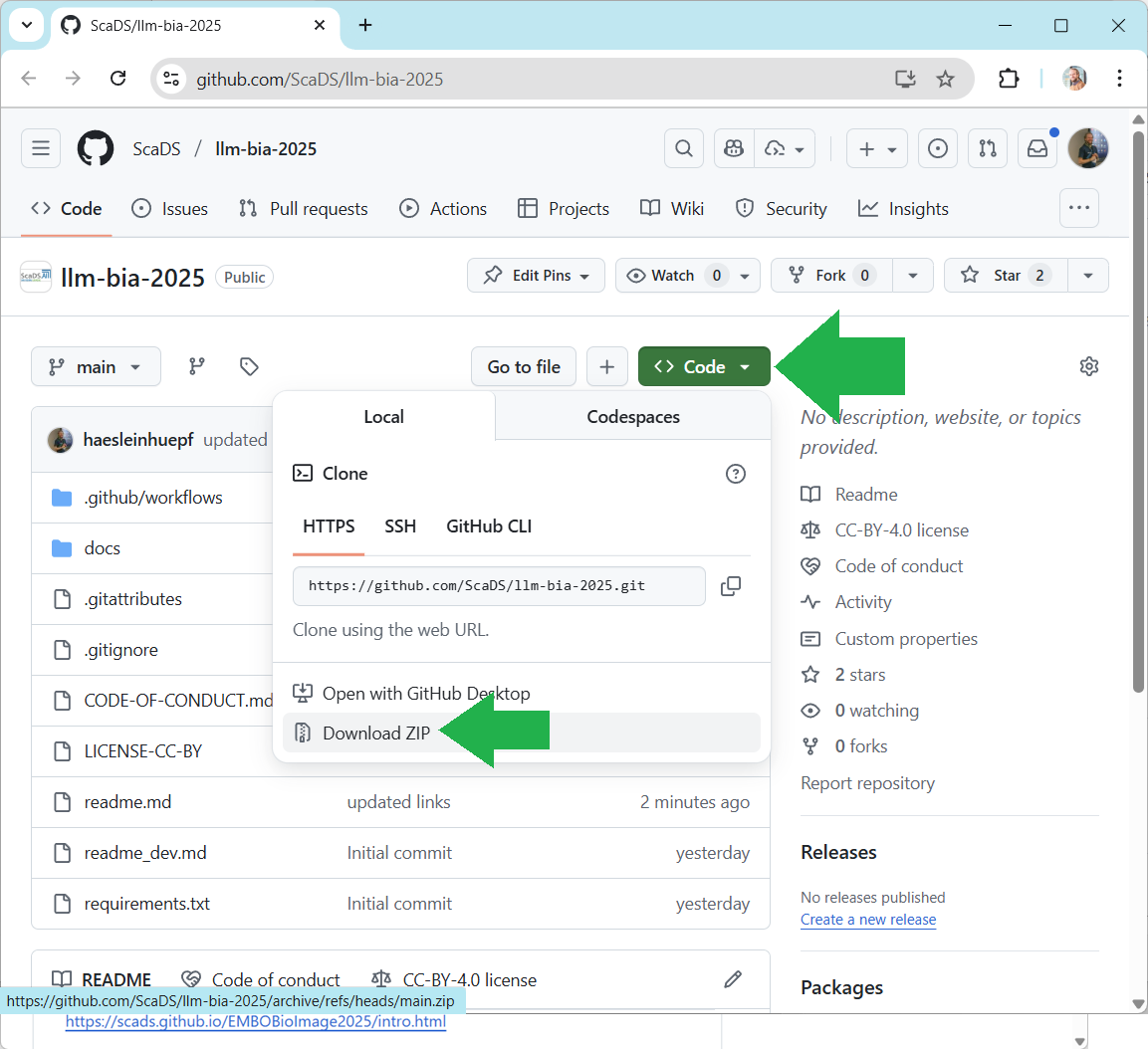
Download the entire repository as ZIP and unzip the files in a place where you can find them. E.g. on your Desktop.
After the ZIP has been unpacked, navigate to the docs folder of the repository using the terminal. E.g. if you downloaded and unpacked the ZIP file on your Desktop, you can do this like this:
cd Desktop
or (if you use OneDrive to sync your Desktop)
cd OneDrive/Desktop
cd embl-bia-2026-main
After arriving in this folder, you can run
uv run jupyter lab
Or, if you prefer using conda, activate your conda environment (if not installed yet, check the installation instructions):
conda activate bia26
jupyter lab

After executing this, you can start Jupyter Lab. On the left side you find folders with exercise notebooks and on the right side you find the notebooks to work on.

Acknowledgements#
We acknowledge the financial support by the Federal Ministry of Education and Research of Germany and by Sächsische Staatsministerium für Wissenschaft, Kultur und Tourismus in the programme Center of Excellence for AI-research „Center for Scalable Data Analytics and Artificial Intelligence Dresden/Leipzig“, project identification number: ScaDS.AI